

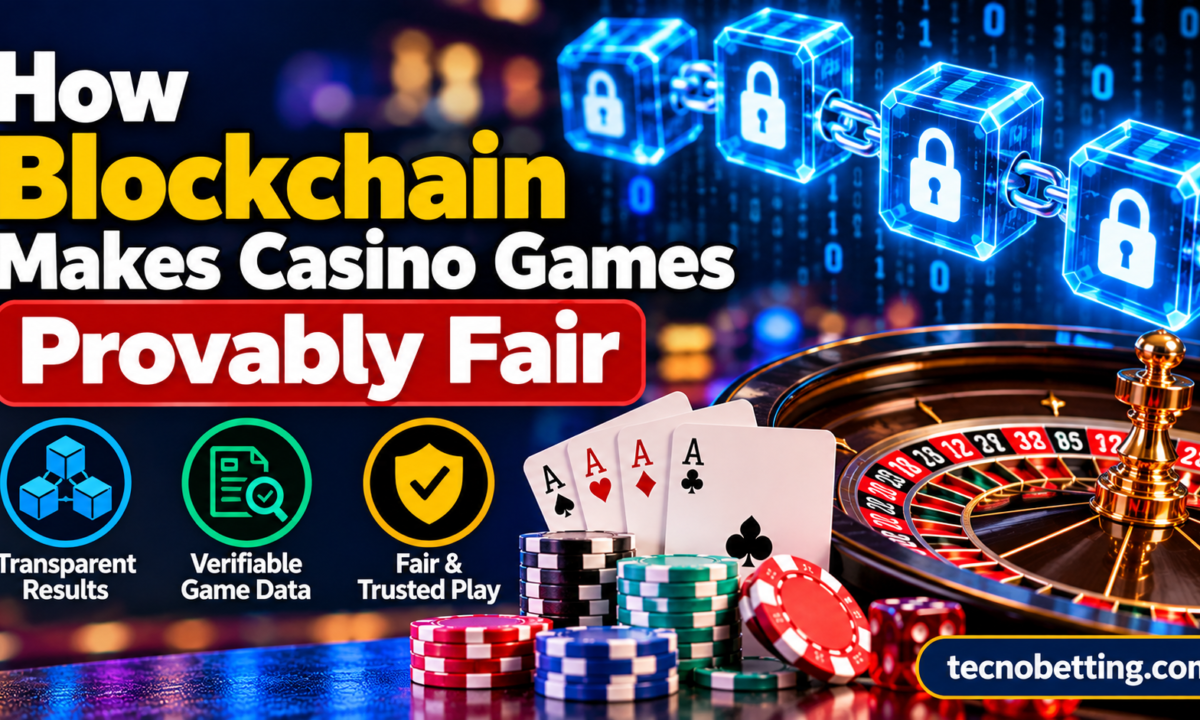
Every online casino asks players for the same thing: trust. Trust that the cards are shuffled randomly, that the roulette ball is not nudged, that the dice are not loaded. For most of the internet’s history, players had to take that on faith, backed by licences and third-party audits they never saw. Blockchain technology introduced a different idea. Instead of asking players to trust the result, a casino can let them verify it. This approach is called provably fair gaming, and it is one of the most useful things crypto has brought to iGaming.
The problem with traditional random number generators
Online casino games run on random number generators, or RNGs. A well-built RNG is a perfectly good way to produce random outcomes, and reputable regulators test them. The weakness is not the maths, it is the visibility. The RNG runs on the operator’s server. The player sees a result, but has no way to check whether that result was produced fairly or chosen after the bet was placed. You rely on the operator’s honesty and on the auditor’s checks.
Provably fair systems keep the RNG idea but change who can check it. They use cryptography so that the casino commits to a result before the bet, and the player can confirm afterwards that the commitment was kept.
Hashes: the building block
The key tool is a cryptographic hash function such as SHA-256, the same family of functions used to secure many public blockchains. A hash function takes any input and turns it into a fixed-length string of characters. Two properties matter here. First, the same input always gives the same output. Second, it is practically impossible to work backwards from the output to the input, or to find a different input that produces the same output.
That means a casino can publish the hash of a secret value without revealing the value itself. Later, when it reveals the secret, anyone can hash it and confirm it matches what was published earlier. If even one character had been changed, the hash would be completely different.
How a provably fair round works
Most provably fair games follow a similar pattern built on three ingredients: a server seed, a client seed and a nonce.
- Server seed: a random secret generated by the casino. Before you play, the casino shows you only its hash.
- Client seed: a value chosen by you or your browser. Because you can change it, the casino cannot predict the final input on its own.
- Nonce: a counter that increases by one with every bet, so each round uses a fresh combination.
When you place a bet, the game combines the server seed, client seed and nonce, usually with a function called HMAC-SHA256, and converts the output into a game result: a card, a dice roll, a crash multiplier or a slot position. After you rotate to a new server seed, the casino reveals the old one. You can then hash it to confirm it matches the hash you were shown at the start, and re-run the calculation for any past bet to confirm the result was exactly what the formula produced.
The beauty of the design is that neither side can cheat alone. The casino committed to its seed before knowing your client seed, and you supplied a client seed without knowing the casino’s secret. The result is fixed the moment both are combined.
Verifying a result yourself
You do not need to be a programmer to check a provably fair bet. Most platforms provide a verification page, and there are independent open-source verifiers as well. The process is usually:
- Copy the revealed server seed, your client seed and the nonce for the bet you want to check.
- Hash the server seed and compare it with the hash shown before you played.
- Run the inputs through the verifier and compare the output with the result you received.
If everything matches, the round was not altered. Checking a handful of bets now and then is a sensible habit, especially on a platform you are trying for the first time.
What provably fair does not mean
Provably fair is about honesty, not generosity. It proves that a result was not manipulated. It does not remove the house edge. A dice game with a 1% edge is still a dice game with a 1% edge, and over many bets the casino still expects to come out ahead. Players should also remember that provably fair applies to specific games, usually in-house titles such as dice, crash, plinko and mines. Third-party slots and live dealer tables generally rely on traditional RNG certification or physical equipment instead.
It also does not replace other checks. Players should still look at how a platform handles withdrawals, which payment networks it supports, what its terms say and whether it holds a licence. Transparency in one area is a good sign, but it is not the whole picture.
Why it matters for the future of iGaming
Provably fair gaming fits naturally with the wider move towards crypto payments. Crypto-native players are used to verifying transactions on a block explorer rather than trusting a bank statement, and they increasingly expect the same openness from the games they play. Stablecoin-focused platforms such as RakeMint, a crypto casino and sportsbook that uses only USDT and USDC, are part of a broader shift in which both the money and the maths become easier for players to inspect.
For the industry, that is healthy. Verifiable results raise the bar for every operator and give players a clear, technical way to separate honest platforms from questionable ones.
Play responsibly
Casino games are for adults aged 18 and over, and only where online gambling is legal. Even with provably fair games, outcomes are random and losses are part of play. Set a budget before you start, never chase losses, and take a break if gaming stops being fun.